Showing posts with label alcohol. Show all posts

Monday, October 12, 2015

We are Delivered: Reflections on the Food Stamp Challenge (post written by Dan)

Dan enjoying a dinner Republicans would be irate about (if paid for with SNAP benefits)
Steak, potatoes, green beans, and of course, alcohol!
It's now been a while since the end of our Foodstamp Challenge, and you see here the celebratory mood that attended our first meal "off of Foodstamps".  I'd like to say that the reason we haven't been heard from for days was the alcohol- and red meat-fueled three-day bender that we went on once we were released (and we did feel like it was a release!), but that's not exactly accurate (though after our martinis & a bottle of wine, we did forget to feed the cat his wet food before we went to bed.
Gorky is not amused.
The truth is we've been packing up for our move.  We leave town in just two days, and have been hemming and hawing over what books we should put in storage, and which ones to bring to Charlottesville (will I really get around to going all the way through The Brothers Karamazov in Virginia?  Or am I just kidding myself?).

I want to reflect on our experience of the Foostamp challenge, but it will probably take a few posts to really think seriously about it.

The one thing I'll say now is that being on Foodstamps, that is limiting all of our consumption the way we did, really did feel like a kind of culinary imprisonment.  Now, we could have drunk wine or beer, and had a cocktail or two throughout the Foodstamp challenge; there is no regulation or oversight of SNAP that actually prohibits these or any other kinds of treats while on Foodstamps, if you have some cash to pay for them, not just your EBT card.

But a lot of voices on the right exhort the moral wrongness of anybody on SNAP affording themselves any physical or emotional comforts beyond the basic needs of human survival.  There are arguments about using "taxpayer dollars" to pay not just for the virtuous consumption of the four foodgroups, but the unvirtuous consumption that extends beyond them.  Some forms of consumption are moral, and others deserve opprobrium.

Of course, there is little complaint from the right when the wealthy buy alcohol, tattoos, cigarettes, or other morally problematic products (and indeed, there's even a double-standard for the poor & the rich on illegal drugs).  But somehow, wealthy people's consumption decisions are morally unassailable.  Personal freedom of choice somehow entitles people to any choices they want--if they are wealthy.

An argument for the justification of policing poor people's consumption choices goes like this: "it's not their money; it's taxpayer money!  So we should get to exert control over, or at least pass moral judgment on what people on Foodstamps buy."

But poor people pay taxes, too!  15.2% payroll taxes from the first dollar of employment, plus income taxes, plus sales taxes that often add up to far higher percentages of their income than the wealthy investor classes (they mostly get to pay just 15% on investment income, even if it runs into the hundreds of thousands of dollars, or 20% once it gets to half a million or more).  So that "taxpayer money" is poor people's money, too!

Moreover, where is the outrage at other morally problematic expenditures, of far larger amounts of "taxpayer money"?  Somehow it cannot be found--at least not on the right.  There exists a great desire in certain halls of conservatism to morally judge and control poor people's behavior--and that desire has found increasing expression in American government policy for a long time in a way that privileged people like me & Jasmine rarely feel.

Well, we got a feel for it while we did the Foodstamp challenge, and it feels terrible.  It does not feel like freedom; it does not feel like opportunity; it does not feel like America.  The minuscule taste we got showed me that to be poor in this country is to be unfree, to be watched, judged, controlled, and bereft of true choice in one's life, much as life is for people who live under totalitarian or theocratic dictatorships.

We're glad to be done with the Foodstamp challenge.  It feels like we live back in America again.

Thursday, October 8, 2015

Badmouthing a Saint: We Find Fault with Brown Rice

Dinner Night 5: Aloo Gobi, Dal, Flatbread, Raita and...brown rice!

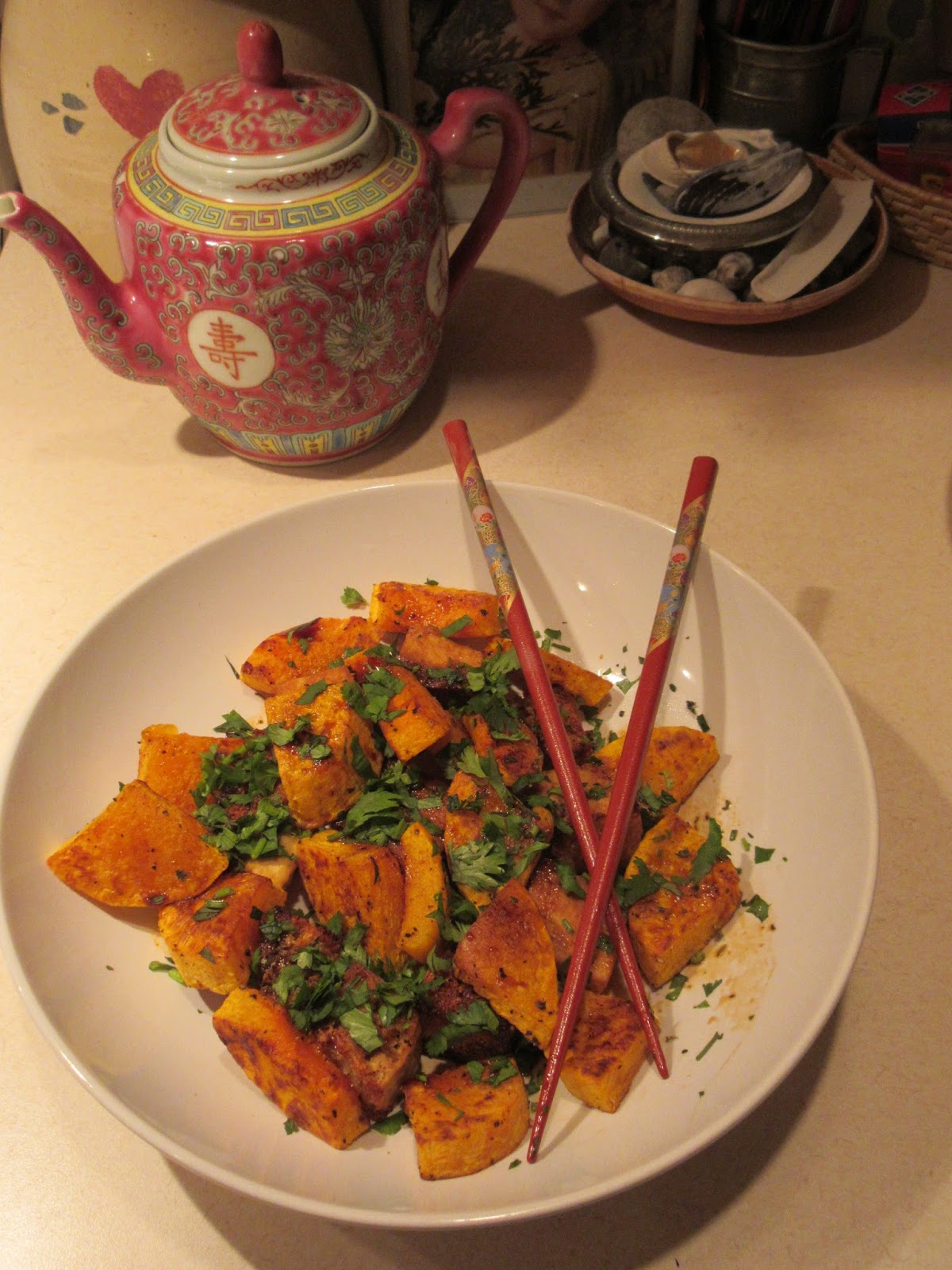
Dinner Night 6: We were riced-out so we had this roasted tofu and butternut squash with soy drizzle and a cilantro shower on its own. It's great that way.

As Dan and I round the bend into our final four meals, and mercifully, last evening without alcohol, which, as we've discussed, has been our greatest challenge, there have been a few notes and impressions thus far worthy of sharing. 

We ran out of butter. I roughly calculated butter under the $3 I budgeted for olive oil (which we still have lots of), but we only had about a stick of it going into the week, and there is about 3/4" of it being carefully maintained for tomorrow's breakfast. Why did we miscalculate butter? Partly because I always think we have it (file this under the assumptions of a person with a well-stocked pantry that need to be rethought to live on food stamps). Partly because when you are eating plain, low-calorie foods like plain oatmeal, brown rice, and bread with one egg, butter is a way of making the meal taste better, satisfy more, and get you to lunch/the next meal. When I have two eggs, I hardly need butter, but with just one, that second piece of toast is dry and the calorie content of the whole breakfast is down, so it comes in to the rescue. And the days when I work, I simply cannot make it from 7 am to almost 2 pm on a half a cup of oatmeal. I become homicidal in the lifeguard chair. I had thought I would be using a little pat of butter here and there to enrich pastas, soup, and dal this week, but I realized shortly in that we would run out, and my have we missed having as much of it as we want. In a week of circumscribed food, you notice the importance of things you took for granted before.

Cooking on food stamps is not as much fun. You may have noticed I am not against planning meals. In regular life, I rather obsess over it, and it's one of my favorite topics for contemplation when I'm up in my lifeguard chair making the big money. I have a rough idea of several meals I want to make over the course of a week, but I change it continually based on what we get from the farm share, what I have a craving for, and if I am inspired by a recipe I happen upon in my endless cooking-oriented procrastinations. Needless to say, when you live on this budget you struggle to come up with a plan to feed everyone for this amount of money, and there is nothing left over. At the beginning I noticed there were no sweets or tea. On day 2 I noticed there was no snack food (unless you want to eat an extra bowl of rice [see below]), and by day 3 I was painfully aware that the spontaneity had gone out of cooking, where I was compelled to execute the simple meals I had planned with the limited ingredients I could afford. I couldn't make an impromptu dessert or appetizer of spring rolls: I simply didn't have the ingredients or couldn't spare them. I couldn't change my mind and make something on a whim. The only wiggle room I had this week was a giant cauliflower I hadn't planned out which became aloo gobi on Indian night. Everything else was a limited-joy execution. Cooking seemed more like work to me this week than it ever has before.

"Fancy" or "fun" foods seem less appealing when I know I have to eat them with water. Dan articulated this first, and he is really right: there's been a sort of reversal in what foods we find it nicest to eat based on the fact that we can't have a glass of wine with them. The foods we see as the least celebratory (last night's roasted tofu and butternut squash being among them, although not because it isn't delicious!) are more pleasant to eat because we notice the absence of a glass of wine (or beer) less. We both agree that our last meal, sardine pasta, is bumming us out because it really deserves a glass of white wine. Normally, the meals we look forward to most are ones that have meat in them, because we eat it rarely. Typically, sausage or sardines at dinner would be a celebrated and special meal for us, but we've found they're sort of depressing when you can't complete the meal with a nice drink. For the record, I did consider buying sparkling water, but it wasn't in the budget, and it probably would have been even more disappointing than just leaning into the tap.

Thank you Asia, for all your wonderful, affordable dishes, but we have arsenic poisoning. It's no news flash that so-called "ethnic" cuisines (it would take not another post but a whole other blog to exhaust my problems with this term) are low in meat and make the most out of grains, vegetables, soy and a perilously-balanced egg on top. And while I think the notion of a "pantry" as a universal concept hides huge disparities in real people's kitchens (one bottle of maple syrup can be worth two or three families' worth of ketchup, mustard, mayo and margarine, to say nothing of the health differences in what people buy: pancake syrup versus maple, olive oil versus corn, etc.), Asian pantry items tend to be eminently affordable. Fish sauce, that old pubic sock juice I can't live without, is practically free. Soy sauce, sriracha, curry paste and even miso paste can generally be gotten for three dollars or so. The better the quality, the higher the price, but that's true even of things there are no cheap versions of. And that's just East Asian cuisines. Once you create an Indian spice cabinet (and if you can find an Indian store you can get massive quantities of spices for very cheap; Wegmans also carries some under the "Lakshmi" brand) you can make any legume or month-old vegetable amazing for a tablespoon of vegetable oil and some time. Any vegetable with garlic in yogurt makes fabulous raita. We've eaten almost exclusively Asian food this week (well I forgot the black beans, which you could call Latin American, I suppose, but which still fit, conveniently, into the "ethnic" category, which I guess means, "not French, not awful" or "may contain cilantro") and there's been lots of variety, terrific tastes, and all of it healthy. What's the catch?

Rice has too much damn arsenic. It's an exceptionally absorbent grass, and is often planted to clean up toxic sites where it absorbs whatever is in the soil. The problem of high arsenic levels in rice has been known long enough that the FDA has considered issuing recommendations on upper limits for rice consumption. Brown rice, which has the highest ratio of healthfulness-to-price of any food widely available, may be even worse than white rice because it has the outer shell of the grain intact. Growing rice organically doesn't address soil absorption, (check out the FDA's circumlocutions on the subject here) and at any rate, organic rice isn't affordable on the SNAP budget. This week, we've eaten almost two pounds of brown rice between us, and even if it weren't getting a little monotonous, it seems that's simply too frequent to eat rice to avoid dangerous levels of arsenic exposure. What this means is that one of the few ways we've found to eat whole grains on a SNAP budget exposes us frequently to a known carcinogen, which, if prolonged indefinitely, could have serious consequences. 

Only one more night of forced smiles ahead.

Tuesday, October 6, 2015

Comfort as Privilege

One impression I carry with me from childhood is of Cybill Shepherd swiveling around in a futuristic egg chair offering a defiant answer to a question that may or may not have been articulated in the hair color commercial: "Because I'm worth it." I would say that statement irritated me as a kid, probably because, without realizing it as such, I did not feel included in it. And I was underage for the target audience. To kids we market via basic, nearly primal desires for things like power, speed and sugar. To adults are added more esoteric and engineered desires curated by lifetimes of receiving all kinds of messages to the point where they feel unartificial and ineluctible. One that has been on my mind is the notion that to treat yourself by buying something is a virtuous act. Consider the pride with which a working mother might announce that she had her nails done, or how a college-age child might lecture a parent on how they need to work less and golf more, or how a department or office might tell its administrative assistant that she needed to take a day off to spend the gift certificate they pooled for at the spa. Work is the premise, or thesis, and the spa is the antithesis. The synthesis is robust capitalism in which workers self-medicate with consumption. I like the spa as much as the next person, but I'm very aware that I can't afford to go to one unless I'm working enough to make it seem much more necessary.

But I've been thinking less about how work necessitates consumption than about what kinds of consumption are open to what kinds of people. Plenty of people work long hours, but not all of them are well-remunerated for it. A family of four with two parents working 40-hour a week at minimum-wage jobs would earn about $2,550 a month, qualifying them for food stamps (the monthly cut-off is $2,668).  Yet I know many people, including Dan and me, who are able between them to work less than two full-time jobs and still exceed the SNAP threshold by a large margin. Those people can not only afford to pay for food from their income, but they can afford a much broader array of "treats" to add a certain level of comfort to their lives. Dan and I live pretty frugally, and there are many non-necessities we forego, such as tobacco, dining out frequently, driving new or expensive cars, clothes, or shoes, or living in a big apartment. If we become more affluent in the future, we will no doubt partake of more of those non-necessities, beginning with a living space that has two bathrooms and a dishwasher. Some of the non-necessities we do afford ourselves we would consider treats, like going out to dinner occasionally, or international vacations; others, like purchasing a farm share and more sustainably-raised meats, don't really confer any special treat sensation, but they are consumption choices we make to gratify our sense of justice and stewardship of animals and the environment. Then there's alcohol.

Alcohol is definitely something we'd call a treat, but it's also a basic part of our diet and our social lives. To me, it's impossible to think about good food without the beverages that go with it because I expect to have them together and I enjoy them so much more together. Like a salad of beets, goat cheese, and walnuts, it's hard to say which of the two would be best without the third, and that's how I feel about most foods without wine or beer. Alcohol also is an ingredient in much of our entertainment: our favorite thing to do together is to mix a cocktail and enjoy it together while we talk or cook or both. It's difficult to write about this and feel that many readers will appreciate my attitude towards alcohol for what it is and not write me off as an alcoholic or an apologist for my own self-indulgence. I'm keenly aware that the prevailing attitudes towards alcohol in our culture are fraught in many different directions. This is a country of bingers and abstainers, and I'm not a registered dietitian telling you cheerily to have one glass of wine with dinner for the bioflavanoids. I'm saying that across the world and throughout history alcohol has been at once a more casual and more indispensible part of human culture than it is presently in the US, and I really appreciate having it as a part of my life to be infrequently, although sometimes, eschewed or overconsumed, but for the most part used the same way people have used that even less-likely demon, bread, as a basic and beloved part of each day.

Being without alcohol this week has me thinking about the notion of comfort. With all alcohol off the table, I feel distinctly bereft of this comfort, and without the option for comfort. Some of this comes from the lack of other things that foodstamps could buy: I can't have a candy or an extra apple if I feel peckish, or just to make the fun of the evening seem to "last" a little past dinner. I can't make tea in the afternoon or an extra pot of coffee if we want it. But it's mainly that the light has been going out of our dinners and their preparation because they're forced into what feels like an excessive deprivation. Thus, the biggest thing I have learned so far about what it feels like to be poor is that the poorer you are the more limited the scope of comforts you can afford is. Booze is expensive, folks, although it hasn't always been that way and it isn't that way everywhere in the world. In the fruit stores in southern Italy where I bought food for many of our blustery picnics, they sold wine from kegs decanted into reused water bottles that were cheaper than Coke. Why can I have a coke this week, or any kind of candy, but no rotgut nero d'avola?

Consider that comfortable is a euphemism for rich: why do we consider comfort so much the province of the affluent, and ridicule the poor for the imagined sushi and lobster they are all eating, but congratulate the wealthy for taking themselves out for a sixty-dollar steak that will be cooked by someone making minimum wage? Why are we forcing the poor to comfort themselves, who for damned sure need comfort no less than the affluent, with tobacco and sugar while we enjoy the heart benefits of nice wines and wild-caught fish?

I have been dubious for some time, probably since September 11, of the weird and inflated status that safety seems to hold in our society. As the country dashed off to war against unknown enemies, I felt that the most abstract conception of our own safety (the victims were already dead, as were the perpetrators [not counting the people who would develop respiratory ailments as a result of their roles in the rescue and clean up who have found it hard to get their care paid for]) was used to justify actions that seemed reckless and unjust. And whose safety did those wars promote? When you look not only at the numbers, but at who died in the wars in Iraq and Afghanistan, it is hard not to see them as the willful sacrifice of a poorer, less well-advocated-for sector of the society for the future safety of who knows whom? Safety was important in that historical moment, but not the safety of the soldiers. In an interview she did for the New York Times, Marilynn Robinson articulated very well this dubiousness I had long felt about how safety was functioning in our society: “What it comes down to — and I think this has become prominent in our culture recently — is that fear is an excuse: ‘I would like to have done something, but of course I couldn’t.’ Fear is so opportunistic that people can call on it under the slightest provocations: ‘He looked at me funny. So I shot him.’” Fear has been used as an excuse for instituting new policies and upholding others, but I would argue that it is the fear for the safety of the already safest members of our society that has motivated politics in recent years, while the least safe grow only more vulnerable in our gun-ridden world of widening income inequality. The poor are poorer, the rich more scared, and everyone has greater access to guns, especially children. We know, too, that the poor are not only the most likely to encounter physical violence, but to live in the areas most prone to noise, air and land pollution, the most susceptible to the ravages of natural disasters, and with the least access to quality education and decently-priced, well-stocked grocery stores.
The bottom line is that the amount of money we have is not related to our virtue, our worthiness as human beings, or how much right we have to the basics of human survival or to the unnecessary "treats" that make life livable, whether they be the wine that makes a meal really good, the martini at the end of the work week, or a well-founded sense of personal security when we eat our meals, breathe our air, leave our homes, or do our jobs. I'll be thinking of that during the next debate in which rich and thickly-sponsored politicians debate what the poor deserve.