Showing posts with label SNAP challenge. Show all posts

Monday, October 12, 2015

We are Delivered: Reflections on the Food Stamp Challenge (post written by Dan)

Dan enjoying a dinner Republicans would be irate about (if paid for with SNAP benefits)
Steak, potatoes, green beans, and of course, alcohol!
It's now been a while since the end of our Foodstamp Challenge, and you see here the celebratory mood that attended our first meal "off of Foodstamps".  I'd like to say that the reason we haven't been heard from for days was the alcohol- and red meat-fueled three-day bender that we went on once we were released (and we did feel like it was a release!), but that's not exactly accurate (though after our martinis & a bottle of wine, we did forget to feed the cat his wet food before we went to bed.
Gorky is not amused.
The truth is we've been packing up for our move.  We leave town in just two days, and have been hemming and hawing over what books we should put in storage, and which ones to bring to Charlottesville (will I really get around to going all the way through The Brothers Karamazov in Virginia?  Or am I just kidding myself?).

I want to reflect on our experience of the Foostamp challenge, but it will probably take a few posts to really think seriously about it.

The one thing I'll say now is that being on Foodstamps, that is limiting all of our consumption the way we did, really did feel like a kind of culinary imprisonment.  Now, we could have drunk wine or beer, and had a cocktail or two throughout the Foodstamp challenge; there is no regulation or oversight of SNAP that actually prohibits these or any other kinds of treats while on Foodstamps, if you have some cash to pay for them, not just your EBT card.

But a lot of voices on the right exhort the moral wrongness of anybody on SNAP affording themselves any physical or emotional comforts beyond the basic needs of human survival.  There are arguments about using "taxpayer dollars" to pay not just for the virtuous consumption of the four foodgroups, but the unvirtuous consumption that extends beyond them.  Some forms of consumption are moral, and others deserve opprobrium.

Of course, there is little complaint from the right when the wealthy buy alcohol, tattoos, cigarettes, or other morally problematic products (and indeed, there's even a double-standard for the poor & the rich on illegal drugs).  But somehow, wealthy people's consumption decisions are morally unassailable.  Personal freedom of choice somehow entitles people to any choices they want--if they are wealthy.

An argument for the justification of policing poor people's consumption choices goes like this: "it's not their money; it's taxpayer money!  So we should get to exert control over, or at least pass moral judgment on what people on Foodstamps buy."

But poor people pay taxes, too!  15.2% payroll taxes from the first dollar of employment, plus income taxes, plus sales taxes that often add up to far higher percentages of their income than the wealthy investor classes (they mostly get to pay just 15% on investment income, even if it runs into the hundreds of thousands of dollars, or 20% once it gets to half a million or more).  So that "taxpayer money" is poor people's money, too!

Moreover, where is the outrage at other morally problematic expenditures, of far larger amounts of "taxpayer money"?  Somehow it cannot be found--at least not on the right.  There exists a great desire in certain halls of conservatism to morally judge and control poor people's behavior--and that desire has found increasing expression in American government policy for a long time in a way that privileged people like me & Jasmine rarely feel.

Well, we got a feel for it while we did the Foodstamp challenge, and it feels terrible.  It does not feel like freedom; it does not feel like opportunity; it does not feel like America.  The minuscule taste we got showed me that to be poor in this country is to be unfree, to be watched, judged, controlled, and bereft of true choice in one's life, much as life is for people who live under totalitarian or theocratic dictatorships.

We're glad to be done with the Foodstamp challenge.  It feels like we live back in America again.

Friday, October 9, 2015

How to Make Sardine Pasta


                                                        How to make Sardine Pasta:
I made this in its simplest iteration last night, our final dinner of the Foodstamp Challenge, with four ingredients: sardines (with their oil/liquid), pasta, onion and dill.
Step 1)

Brown as many onions as you have in the oil and liquid from a can (or 2) of sardines packed in olive oil. I used 1/2 lb pasta to 2 cans. You can alter the proportions as you like. Add salt, pepper and red pepper flakes. Other nice, but unnecessary additions: fennel seed, fennel bulb, garlic.
Step 1-1/2)
No, brown them.
Step 2)
Add partly-cooked pasta while it's pretty stiff and a cup or so of pasta water. Scrape the bottom of the pan, soften the pasta, and cook until the liquid's gooey and almost gone.
Step 3)
Toss in sardines and any green herbs (we like dill best) at the last minute.
Step 4)
Enjoy with a big glass of water and copious self-congratulation on your personal virtue.
Unrelated, but to come back to an earlier comment:
Dan, who tightened his belt (literally!) on butter intake, showing he managed to leave a little bit left after the last breakfast of the week.


Thursday, October 8, 2015

Badmouthing a Saint: We Find Fault with Brown Rice

Dinner Night 5: Aloo Gobi, Dal, Flatbread, Raita and...brown rice!

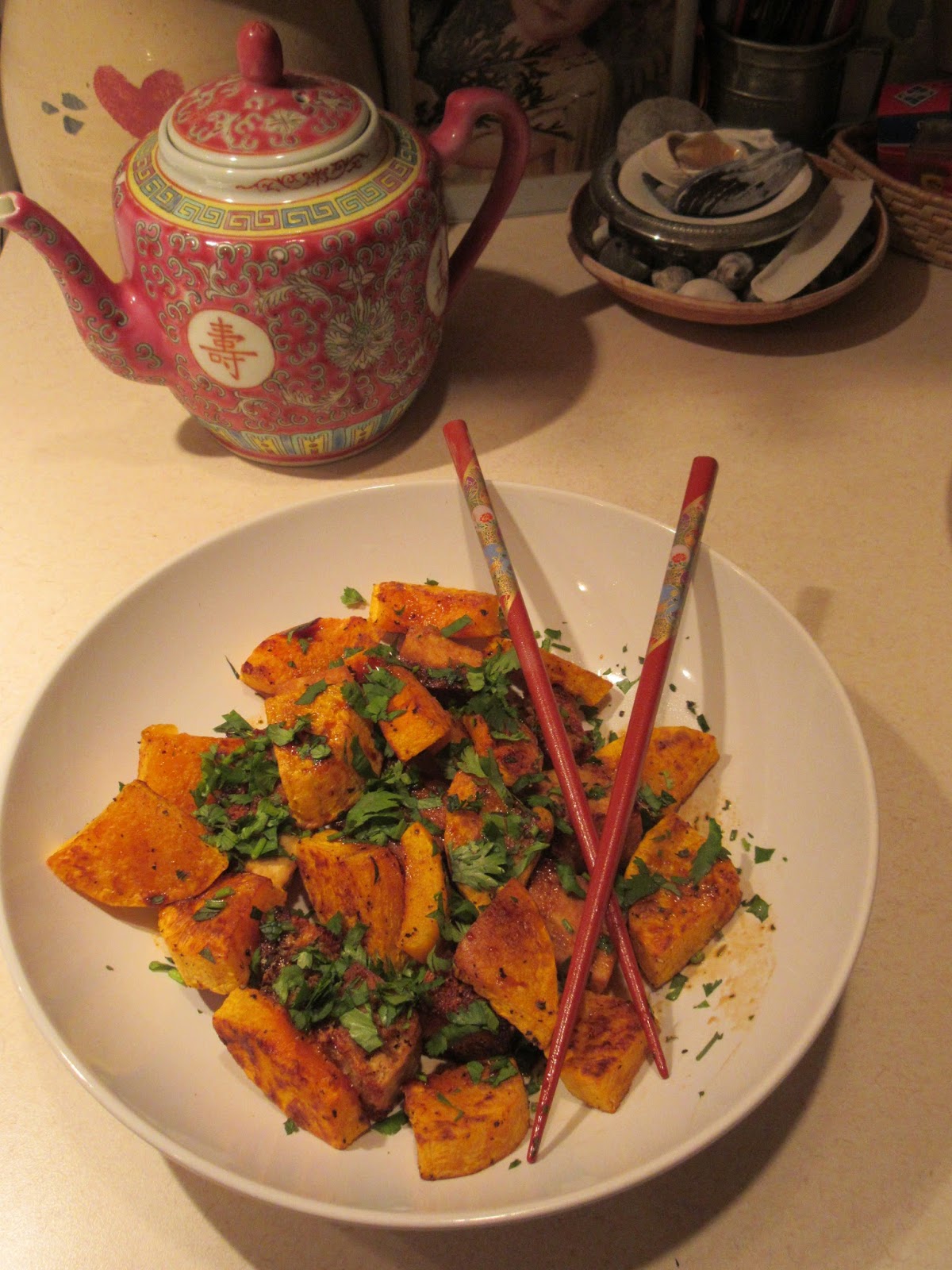
Dinner Night 6: We were riced-out so we had this roasted tofu and butternut squash with soy drizzle and a cilantro shower on its own. It's great that way.

As Dan and I round the bend into our final four meals, and mercifully, last evening without alcohol, which, as we've discussed, has been our greatest challenge, there have been a few notes and impressions thus far worthy of sharing. 

We ran out of butter. I roughly calculated butter under the $3 I budgeted for olive oil (which we still have lots of), but we only had about a stick of it going into the week, and there is about 3/4" of it being carefully maintained for tomorrow's breakfast. Why did we miscalculate butter? Partly because I always think we have it (file this under the assumptions of a person with a well-stocked pantry that need to be rethought to live on food stamps). Partly because when you are eating plain, low-calorie foods like plain oatmeal, brown rice, and bread with one egg, butter is a way of making the meal taste better, satisfy more, and get you to lunch/the next meal. When I have two eggs, I hardly need butter, but with just one, that second piece of toast is dry and the calorie content of the whole breakfast is down, so it comes in to the rescue. And the days when I work, I simply cannot make it from 7 am to almost 2 pm on a half a cup of oatmeal. I become homicidal in the lifeguard chair. I had thought I would be using a little pat of butter here and there to enrich pastas, soup, and dal this week, but I realized shortly in that we would run out, and my have we missed having as much of it as we want. In a week of circumscribed food, you notice the importance of things you took for granted before.

Cooking on food stamps is not as much fun. You may have noticed I am not against planning meals. In regular life, I rather obsess over it, and it's one of my favorite topics for contemplation when I'm up in my lifeguard chair making the big money. I have a rough idea of several meals I want to make over the course of a week, but I change it continually based on what we get from the farm share, what I have a craving for, and if I am inspired by a recipe I happen upon in my endless cooking-oriented procrastinations. Needless to say, when you live on this budget you struggle to come up with a plan to feed everyone for this amount of money, and there is nothing left over. At the beginning I noticed there were no sweets or tea. On day 2 I noticed there was no snack food (unless you want to eat an extra bowl of rice [see below]), and by day 3 I was painfully aware that the spontaneity had gone out of cooking, where I was compelled to execute the simple meals I had planned with the limited ingredients I could afford. I couldn't make an impromptu dessert or appetizer of spring rolls: I simply didn't have the ingredients or couldn't spare them. I couldn't change my mind and make something on a whim. The only wiggle room I had this week was a giant cauliflower I hadn't planned out which became aloo gobi on Indian night. Everything else was a limited-joy execution. Cooking seemed more like work to me this week than it ever has before.

"Fancy" or "fun" foods seem less appealing when I know I have to eat them with water. Dan articulated this first, and he is really right: there's been a sort of reversal in what foods we find it nicest to eat based on the fact that we can't have a glass of wine with them. The foods we see as the least celebratory (last night's roasted tofu and butternut squash being among them, although not because it isn't delicious!) are more pleasant to eat because we notice the absence of a glass of wine (or beer) less. We both agree that our last meal, sardine pasta, is bumming us out because it really deserves a glass of white wine. Normally, the meals we look forward to most are ones that have meat in them, because we eat it rarely. Typically, sausage or sardines at dinner would be a celebrated and special meal for us, but we've found they're sort of depressing when you can't complete the meal with a nice drink. For the record, I did consider buying sparkling water, but it wasn't in the budget, and it probably would have been even more disappointing than just leaning into the tap.

Thank you Asia, for all your wonderful, affordable dishes, but we have arsenic poisoning. It's no news flash that so-called "ethnic" cuisines (it would take not another post but a whole other blog to exhaust my problems with this term) are low in meat and make the most out of grains, vegetables, soy and a perilously-balanced egg on top. And while I think the notion of a "pantry" as a universal concept hides huge disparities in real people's kitchens (one bottle of maple syrup can be worth two or three families' worth of ketchup, mustard, mayo and margarine, to say nothing of the health differences in what people buy: pancake syrup versus maple, olive oil versus corn, etc.), Asian pantry items tend to be eminently affordable. Fish sauce, that old pubic sock juice I can't live without, is practically free. Soy sauce, sriracha, curry paste and even miso paste can generally be gotten for three dollars or so. The better the quality, the higher the price, but that's true even of things there are no cheap versions of. And that's just East Asian cuisines. Once you create an Indian spice cabinet (and if you can find an Indian store you can get massive quantities of spices for very cheap; Wegmans also carries some under the "Lakshmi" brand) you can make any legume or month-old vegetable amazing for a tablespoon of vegetable oil and some time. Any vegetable with garlic in yogurt makes fabulous raita. We've eaten almost exclusively Asian food this week (well I forgot the black beans, which you could call Latin American, I suppose, but which still fit, conveniently, into the "ethnic" category, which I guess means, "not French, not awful" or "may contain cilantro") and there's been lots of variety, terrific tastes, and all of it healthy. What's the catch?

Rice has too much damn arsenic. It's an exceptionally absorbent grass, and is often planted to clean up toxic sites where it absorbs whatever is in the soil. The problem of high arsenic levels in rice has been known long enough that the FDA has considered issuing recommendations on upper limits for rice consumption. Brown rice, which has the highest ratio of healthfulness-to-price of any food widely available, may be even worse than white rice because it has the outer shell of the grain intact. Growing rice organically doesn't address soil absorption, (check out the FDA's circumlocutions on the subject here) and at any rate, organic rice isn't affordable on the SNAP budget. This week, we've eaten almost two pounds of brown rice between us, and even if it weren't getting a little monotonous, it seems that's simply too frequent to eat rice to avoid dangerous levels of arsenic exposure. What this means is that one of the few ways we've found to eat whole grains on a SNAP budget exposes us frequently to a known carcinogen, which, if prolonged indefinitely, could have serious consequences. 

Only one more night of forced smiles ahead.

Wednesday, October 7, 2015

Value a major secret to living well: unpaid household work

If some people have been following our blog and been attracted to and impressed by what we've been eating--from Fried Rice to Dal & Aloo Gobi, or even just sausages with peppers & onions and mashed peas, you've hopefully realized that the reason we eat so well is all the cooking Jasmine does, how well she does it, and perhaps most importantly (especially for the SNAP challenge), that she cooks from scratch.

This last means that not only are our meals more healthy, because they don't have a lot of processing or preserving chemicals in them, but also that the cost of food is quite low, compared to pre-prepared or partly-prepared foods that I used to eat (like jarred spaghetti sauce, Trader Joe's Mandarin Orange Chicken, etc) before Jasmine was in my life.

But we can eat this way only because we, as a unit, have the time, energy, and willingness to invest in this unpaid household labor.  And by "we," I mean Jasmine, who does almost all of it in our house. We've been able to afford mostly because, until I quit Colgate, I was making a lot more money than she, as she was teaching part-time, on an adjunct basis, and not put upon with any (in truth, I should say "as many") extra administrative responsibilities as I was.  So she has had time & energy to spare for unpaid household labor.

This rather traditional (but not un-progressive) arrangement seemed to come rather naturally to us, partly because for Jasmine to achieve greatness as a poet doesn't necessarily depend on slogging through the trenches of typical academia, whereas for me to achieve . . . well greatness is not exactly the right word . . . as a political scientist, does require it.  But also because Jasmine has a knack and a penchant for performing such household labor excellently.  While I would be slogging at the office, Jasmine has always been willing to slog through the trenches of baking no-knead bread, perfecting new recipes, taking charge of nutrition & shopping, not to mention other important aspects of unpaid household work, like doing laundry, cleaning, doing the dishes.

We were lucky, though, because of how much money I earned: in fact, it put us in the top 25% of households according to income.  My salary alone was only around $15k less than couples where both work.

But this is not most people's experience: in 2008, the median income for (heterosexual) couples where only the husband worked was about $30k less than if they both worked; among couples where only the wife worked, it was $40k less.  Those differences of $30k-$40k of annual income in America makes the difference between a secure place in the upper-middle class (the median income of a family where both parents work would place them above about 85% of households in our country), and a struggle to pay for even some of the many accoutrements of middle-class life: nice house, two cars, vacations, sports or lessons for kids, family vacations, ample retirement funds & college funds, a TV or two, cable, smartphones etc.

And indeed, all this is aside from the constantly hard-pressed situation of single-parent families, whom the combination of government + consumption demands expect to work at least one full-time job, and often more, and who also get almost no help paying for child-care.  The idea that a single-parent ought to stay home most of the day and perform the kind of unpaid labor that Jasmine does to make our lives excellent, much less to provide care, and solid parenting, self esteem, and life-lessons for his (or, as well all know is far more frequently the case, her) own children would be anathema to most of the political & budgetary establishment of this country, who would never countenance the idea of such "takers" getting any outside support for the task of raising the next generation of Americans instead of working multiple low-wage jobs and paying through the nose for childcare.

Why do we live in a society where so many of the things that make family life rich, delicious, and a good environment for raising children are considered "luxuries" that ought to give place to retirement & college savings, and other "normal" middle-class consumption expectations (unless you're really rich)?

It's a tough question, and it's not all about politics or policy, but there are ways that policy can support people bucking the trends of our society, and does, in other countries, like Germany, Sweden, and Switzerland, which Bernie wants to emulate.  In America, it will take a revolution to change these kinds of things--the political revolution that Bernie is calling us to is not the whole solution (just as getting Bernie elected president is not the whole of the political revolution this country needs; we need big change in Congress, too!).  But a political revolution is a good beginning to get people thinking about how lots of things need to be different in this country, including the how we value (and how our government encourages us to value) to value family & labor (both unpaid in the house, as well as outside the home).  That's one big reason why we're for Bernie.

Tuesday, October 6, 2015

Day 3 & Day 4 dinners, plus extra pics of Dan's most recent salon experience

Black Beans and fixins.

The best thing about leftover rice: Tamar Adler's Thai Fried Rice. Just don't expect to poach an egg that perfectly every time.

Another method of economizing that we've been employing for a year or so: I'm not great at cutting hair, but I'm as good as a lot of the people in Boston Dan paid $15 to do it. So I do it.

Comfort as Privilege

One impression I carry with me from childhood is of Cybill Shepherd swiveling around in a futuristic egg chair offering a defiant answer to a question that may or may not have been articulated in the hair color commercial: "Because I'm worth it." I would say that statement irritated me as a kid, probably because, without realizing it as such, I did not feel included in it. And I was underage for the target audience. To kids we market via basic, nearly primal desires for things like power, speed and sugar. To adults are added more esoteric and engineered desires curated by lifetimes of receiving all kinds of messages to the point where they feel unartificial and ineluctible. One that has been on my mind is the notion that to treat yourself by buying something is a virtuous act. Consider the pride with which a working mother might announce that she had her nails done, or how a college-age child might lecture a parent on how they need to work less and golf more, or how a department or office might tell its administrative assistant that she needed to take a day off to spend the gift certificate they pooled for at the spa. Work is the premise, or thesis, and the spa is the antithesis. The synthesis is robust capitalism in which workers self-medicate with consumption. I like the spa as much as the next person, but I'm very aware that I can't afford to go to one unless I'm working enough to make it seem much more necessary.

But I've been thinking less about how work necessitates consumption than about what kinds of consumption are open to what kinds of people. Plenty of people work long hours, but not all of them are well-remunerated for it. A family of four with two parents working 40-hour a week at minimum-wage jobs would earn about $2,550 a month, qualifying them for food stamps (the monthly cut-off is $2,668).  Yet I know many people, including Dan and me, who are able between them to work less than two full-time jobs and still exceed the SNAP threshold by a large margin. Those people can not only afford to pay for food from their income, but they can afford a much broader array of "treats" to add a certain level of comfort to their lives. Dan and I live pretty frugally, and there are many non-necessities we forego, such as tobacco, dining out frequently, driving new or expensive cars, clothes, or shoes, or living in a big apartment. If we become more affluent in the future, we will no doubt partake of more of those non-necessities, beginning with a living space that has two bathrooms and a dishwasher. Some of the non-necessities we do afford ourselves we would consider treats, like going out to dinner occasionally, or international vacations; others, like purchasing a farm share and more sustainably-raised meats, don't really confer any special treat sensation, but they are consumption choices we make to gratify our sense of justice and stewardship of animals and the environment. Then there's alcohol.

Alcohol is definitely something we'd call a treat, but it's also a basic part of our diet and our social lives. To me, it's impossible to think about good food without the beverages that go with it because I expect to have them together and I enjoy them so much more together. Like a salad of beets, goat cheese, and walnuts, it's hard to say which of the two would be best without the third, and that's how I feel about most foods without wine or beer. Alcohol also is an ingredient in much of our entertainment: our favorite thing to do together is to mix a cocktail and enjoy it together while we talk or cook or both. It's difficult to write about this and feel that many readers will appreciate my attitude towards alcohol for what it is and not write me off as an alcoholic or an apologist for my own self-indulgence. I'm keenly aware that the prevailing attitudes towards alcohol in our culture are fraught in many different directions. This is a country of bingers and abstainers, and I'm not a registered dietitian telling you cheerily to have one glass of wine with dinner for the bioflavanoids. I'm saying that across the world and throughout history alcohol has been at once a more casual and more indispensible part of human culture than it is presently in the US, and I really appreciate having it as a part of my life to be infrequently, although sometimes, eschewed or overconsumed, but for the most part used the same way people have used that even less-likely demon, bread, as a basic and beloved part of each day.

Being without alcohol this week has me thinking about the notion of comfort. With all alcohol off the table, I feel distinctly bereft of this comfort, and without the option for comfort. Some of this comes from the lack of other things that foodstamps could buy: I can't have a candy or an extra apple if I feel peckish, or just to make the fun of the evening seem to "last" a little past dinner. I can't make tea in the afternoon or an extra pot of coffee if we want it. But it's mainly that the light has been going out of our dinners and their preparation because they're forced into what feels like an excessive deprivation. Thus, the biggest thing I have learned so far about what it feels like to be poor is that the poorer you are the more limited the scope of comforts you can afford is. Booze is expensive, folks, although it hasn't always been that way and it isn't that way everywhere in the world. In the fruit stores in southern Italy where I bought food for many of our blustery picnics, they sold wine from kegs decanted into reused water bottles that were cheaper than Coke. Why can I have a coke this week, or any kind of candy, but no rotgut nero d'avola?

Consider that comfortable is a euphemism for rich: why do we consider comfort so much the province of the affluent, and ridicule the poor for the imagined sushi and lobster they are all eating, but congratulate the wealthy for taking themselves out for a sixty-dollar steak that will be cooked by someone making minimum wage? Why are we forcing the poor to comfort themselves, who for damned sure need comfort no less than the affluent, with tobacco and sugar while we enjoy the heart benefits of nice wines and wild-caught fish?

I have been dubious for some time, probably since September 11, of the weird and inflated status that safety seems to hold in our society. As the country dashed off to war against unknown enemies, I felt that the most abstract conception of our own safety (the victims were already dead, as were the perpetrators [not counting the people who would develop respiratory ailments as a result of their roles in the rescue and clean up who have found it hard to get their care paid for]) was used to justify actions that seemed reckless and unjust. And whose safety did those wars promote? When you look not only at the numbers, but at who died in the wars in Iraq and Afghanistan, it is hard not to see them as the willful sacrifice of a poorer, less well-advocated-for sector of the society for the future safety of who knows whom? Safety was important in that historical moment, but not the safety of the soldiers. In an interview she did for the New York Times, Marilynn Robinson articulated very well this dubiousness I had long felt about how safety was functioning in our society: “What it comes down to — and I think this has become prominent in our culture recently — is that fear is an excuse: ‘I would like to have done something, but of course I couldn’t.’ Fear is so opportunistic that people can call on it under the slightest provocations: ‘He looked at me funny. So I shot him.’” Fear has been used as an excuse for instituting new policies and upholding others, but I would argue that it is the fear for the safety of the already safest members of our society that has motivated politics in recent years, while the least safe grow only more vulnerable in our gun-ridden world of widening income inequality. The poor are poorer, the rich more scared, and everyone has greater access to guns, especially children. We know, too, that the poor are not only the most likely to encounter physical violence, but to live in the areas most prone to noise, air and land pollution, the most susceptible to the ravages of natural disasters, and with the least access to quality education and decently-priced, well-stocked grocery stores.
The bottom line is that the amount of money we have is not related to our virtue, our worthiness as human beings, or how much right we have to the basics of human survival or to the unnecessary "treats" that make life livable, whether they be the wine that makes a meal really good, the martini at the end of the work week, or a well-founded sense of personal security when we eat our meals, breathe our air, leave our homes, or do our jobs. I'll be thinking of that during the next debate in which rich and thickly-sponsored politicians debate what the poor deserve.

Sunday, October 4, 2015

Home Economics and How Easy it is to Think Food Costs Less than it Does

First, a picture of our first challenge Lunch, Saturday Oct 3, then some thoughts from Jasmine on economics.
Broccoli soup with cheddar cheese & the first slice of the week's homemade bread: wheat/oat.
The Food Stamp Challenge is in some ways made for me (Jasmine). Not only, as Dan pointed out, are we living on a budget and likely to do so for some time, but I’ve been practicing home economics for as long as I can remember and I am an inveterate planner of groceries and meals. Growing up, I always went to the grocery store with my mom, who taught me pretty much everything there is to know about shrewd shopping. I cannot remember a time when I  didn’t understand the principle of price-per-unit, and I also can’t remember as far back as the first time I realized that stores frequently confuse even this solid indication of price by measuring different brands of the same product in different units (one can of tomatoes in fluid ounces with another in grams: neither the same system not the same measure—this really happens!). My mom was also a throwback to the generation before her own when it came to maximizing, saving and reusing things in the home. She is a baby boomer and did not experience the want of food growing up, while her mother grew up during the Depression raising chickens that the family could rarely afford to kill for their own table. Yet my grandmother wasn’t overly economical, and my mother is. When she and my dad were first married they lived on a witheringly small graduate student stipend and food stamps with a small child; perhaps that left its mark. And although she enjoyed a period of relative comfort when my family lived in Saudi Arabia, for many years of my childhood money was tight. After they moved back it took my dad a long time to find a teaching job, and he painted houses and adjuncted while she worked full-time as a waitress. Even after he began his tenure-track job, the long payless summers in sweltering south Jersey had an unshakable drear to them and September was something she and I, sharing the problem of how to have a nice home and life without lots of resources, often openly longed for.  In September, we could go out to dinner on Fridays and buy whatever we wanted at ShopRite.

I don’t wish to falsify that I grew up poor; my family was middle class and I never experienced hunger. If we could have used more money, it was in part because I was sent to private violin lessons. We were in that kind of situation. I am unusual in that I was aware of the pinch of limited money and involved in helping to solve the problems it presents from a young age. Although I can imagine wanting to hide any sense of limitation and privation from a child, I am glad my mom let me in on these things, in part because I find household management really interesting and rewarding, and even more because there was never a time in which I didn’t know thoroughly how money works, that it is possible to get through not having a lot of it, and how that can be done.

But the situation I’ve been in, and which I am to some degree in today, is really different from what a lot of people experience. I do not know what it is like to have nothing in my pantry. My dad has stories from his childhood when there was one thing in the kitchen (oatmeal) which he tried to make into cookies but ended up ruining the last of the food; in another, he hallucinates from hunger while watching a strange Sunday afternoon tv program when his mother opens the door carrying a bag of groceries with the fronds of a bunch of celery sticking out of the top like some kind of tropical saint. I haven’t had those experiences, and I know they are on a whole other order of desperation than the challenges I’ve faced. I also recognize that the fact that I cook at all, that I bake, that I read the store circular every week, grow a garden and shop at multiple stores for the best prices, and that I know not only how to do things in the kitchen but how to do them in the way that maximizes their value, is something not everyone has. The fact that I have the time to do these things is also a privilege that not everyone has. I have heard that there is a saying in southern Italy along the lines of, “We don’t have money but we have time.” This implies that humble ingredients can be wonderful if cooked with skill and not rushed, and it also implies that time is free. But many poor people cannot afford time, and most working Americans, poor or rich, would certainly say that time is a rare and valuable commodity.

Privilege is something that it is impossible to disentangle from your life for the sake of experiencing what someone else goes through. Planning for this week has been difficult in part for that very reason: we have a garden and a CSA farm share. Because we can afford the several-hundred-dollar up-front investment in this local farm, I have to buy almost no produce for five months of the year, and we get lots of the highest-quality organic produce for an embarrassingly low price-per-unit. But what about somebody on minimum wage, for whom a share costs 2/3 of a month's after-tax income? Through that farm and our community garden, we also have unlimited herbs and for a little longer this year tomatoes, zucchini and hot peppers. We also have an Amish population here so we can get terrific eggs for $2 a dozen. Most people just don’t have access to any of these things which enable great eating for little money, and I have had to go to some lengths to create a more representative food situation for us: I have used several crops from the farm and calculated their value according to the prices our local supermarket charges. We will not have anything not available at that store (Price Chopper) or whose price wouldn’t fit the budget. In fact, we on our last night before the challenge we feasted ourselves and a few friends on perishable produce that wouldn’t fit in the budget, and I imagine that many people on SNAP, on the last night before the new week of benefits begins, end up eating the dregs of their week’s groceries rather than enjoying a final seasonal feast. Still, I am relieved that the week is beginning because it was so difficult trying to get it right ahead of time, and now we’ll just have to see if I did. I am very aware that if I misplanned, we do have other options, and that’s just what many people on food stamps don’t have.

At first I thought $58 for two people for a week sounded like a lot. I’m embarrassed about that now, but it should be said because I bet a lot of people whose endless appetite for spending cuts fixates on SNAP think the same thing: “That seems like plenty of money to me!” I rarely spend as much as $58 in one trip to the grocery store, primarily because of our farm share, but also because I buy a lot of things at multiple locations that have better prices or quality whenever I have the opportunity. When we go to a big city, we often go to Trader Joe’s to stock up on grains, pasta, meats, coffee and toiletries. When we go to Utica I buy brown Jasmine rice and Asian sauces at the Asian market there. I make a trip to our local health food store about once a month for bulk legumes and spices, which are the only things there I consider affordable. All those shopping trips assume a car, gas money, and that you are not living on a week-to-week budget. One thing a person on SNAP might be hard-pressed to finance is a big, impromptu antibiotic-free meat purchase at Trader Joes. So when I jotted down some probable meals for the Challenge week, I had to completely re-think how to shop for dinner.
I knew, for example, that we would have black beans. It’s pretty much Dan’s favorite food, and we have it often anyway. It’s cheap and it makes a lot. My mind initially went to all the things I normally buy to put in it or with it: green and jalapeno pepper, yogurt and cheese if we could fit them into hte $58 budget, some raw vegetable or salsa, and tortillas. I forgot to put the beans and rice on the list. That’s because I always have beans and rice. I never buy them acutely, so to speak. That is the essence of the privilege we need to consider in a challenge like this. Once I added those to the list, there was $4 less for everything else, and I knew this round of black beans would be a more sober version of what is often a rather lavish meal for all that it is vegetarian and relatively cheap.

Picture of Dinner from Saturday Night--a night when the fruit of the vine would always otherwise enliven our dinner and evening's entertainment. But tonight, it was not to be . . .
Note four bowls for a half-pound of pasta: two dinner portions & two pyrex dishes for Sunday's lunch

Saturday, October 3, 2015

Meal Pics & Plan: The Dubious Wisdom of Coupons, and Impediments to Eating Sustainably

Meal Plan (Subject to Rearrangement):


Breakfast
Lunch Dinner
Friday


Sausage, Pea Puree, Peppers & Onions
Saturday Waffles & Eggs Broccoli Soup Pasta, Sausage, & Roasted Red Peppers
Sunday Toast & Eggs Soup/Pasta Black Beans (“poor man's feijoada")
Monday Oatmeal Black Beans Fried Rice with Egg
Tuesday Toast & Eggs Beans/Soup/Rice Dal with Flatbread & Raita
Wednesday Oatmeal Dal Tofu & Butternut Squash
Thursday Toast & Eggs Potatoes & Veg Sardine Pasta
Friday Toast & Eggs Sardine Pasta


First Meal: Friday night, we dress for dinner after the first gong (Dan caught running by the camera timer).

A closer look at the first meal--the sausage is hiding under all those sautéed peppers & onions!
Second meal: breakfast, including extra-budgetary condiments (allowed under Challenge rules).  There is an apple for Dan (budgeted), because I insist on eating fruit with breakfast every morning.
Note: At Dan’s suggestion, I mixed a couple leftover tablespoons of pea puree into my egg, hence the green egg waffle sandwich. It was wonderful.
Jasmine loves herself a breakfast sandwich!
        Since Dan and I love meat but don’t eat too much of it, and because we like to make a small holiday out of weekend nights, we’ve frontloaded our Food Stamp Challenge week with what will be probably our most opulent dinners because they involve one of our two meat products: turkey sausage. I’ve never delved into the world of turkey sausage before because the point of sausage seems to me to be fat and lots of it, and preferably pork fat, but I found a coupon for a brand of turkey products that makes some claims to superior practices, and we are fond of buying meat that makes claims to superior practices. In this case, the turkey supposedly is raised without antibiotics and hormones by independent farmers “trained on animal handling practices.” I’m perplexed about whether the use of the preposition “on” instead of “in” actually hides some oddness of meaning; at any rate I am not bursting with confidence that this label really means anything about the healthiness of the product or the welfare of the animals who died for it, but in this puzzling world such promises seem better than nothing. Thus, it has been our practice for a couple years to mainly, most of the time, unfortunately not always, buy such claimful meat products and it ultimately helps us eat less meat since they are generally more expensive. In this case, the sausage seemed a pretty great deal: not much more than the store brand pork sausage, and with the coupon a little less.
        I am very skeptical about coupons. Every website that discusses either how to approach this challenge specifically or how to approach budget cooking in general insists upon the use of coupons, but I find that I never, or very rarely, encounter coupons. The main source of coupons as I understand them is Sunday newspapers, and I found mine in my parents’ Sunday newspaper when I was visiting them last week. If a newspaper costs several dollars (The New York Times is $6 in Hamilton, for example) and all you can find in it that you could possibly justify buying on a food stamp budget is turkey sausage, then for that 75 cent coupon you are at a $5.25 loss. If they were full of coupons like $1 off fresh broccoli or 50 cents off plain rice, they might be worth seeking out. But coupons do not encourage people to buy necessary products, but rather the ones manufacturers will make the most money from—coupons are marketing tools, and thus they often work only for new products that are excessively pigeonholed and ultimately silly, like spray margarine made from olive oil, or the newest, strangest line of wasteful cleaning apparati from Swiffer, which are only intended to be sold temporarily to give Procter & Gamble stock what Mitt Romney might call a "sugar high."
        Back to meat. I have long felt that cured pork products like salami, bacon, prosciutto, pepperoni and the like are wonderful tools in a low-meat diet, because they go a long way. They are also fraught with carcinogens from a chemical reaction between the meat itself and the nitrites added to preserve the color (and don’t fall for the ingredient “celery extract.” It’s full of nitrites and the result is the same. Find more depressing information about so-called “clean labels” here). Still, eating less meat is probably more important for good health and curbing your consumption of the various (carbon, water, land, human and animal rights) excesses the meat industry is so guilty of than eating plenty of the best meat. And for goodness sake cured meats are delicious. But canned fish is an often-overlooked runner-up: anchovies are famous for their inordinate amount of flavor, but canned sardines and mackerel have a wonderful, rich umami taste and  they’re bigger and meatier, cheap as can be, and lousy with healthy fats. Canned salmon and tuna are also great and when you use them as a topping or mixed with other things (like salmon burgers that are half sautéed vegetables or tuna-potato or tuna-white bean salad) they seem to stretch endlessly across servings. It’s important to say, because no one does, that these fish all come with bones that you should ignore, as they’re terrific for you and totally unnoticeable; in fact they disintegrate if you try to remove them anyway. Paying twice as much for boneless canned fish is a waste. We’ll have pasta with sardines this week, and it’s a truly splendid, rich dish you should try if you never have. And splurge for dill if you can.

        All this is circumlocution around a point that I had better say plainly: the only way to eat meat that is remotely sustainable on this budget is to eat extremely little of it and to be willing to eat meats of little esteem. To that point, it is also not possible to eat much organic food on this budget except, as with sustainable meat, if you just have very little of it. And that means that, as with so many things, there is a double standard for the poor concerning high-quality food. Although there is nothing to say that either bearing the responsibility of consuming sustainable food or reaping the health benefits of that food ought to be the exclusive purview of the rich, these consumption choices effectively are non-existent for anyone who needs help paying for food: eat the cheapest food, however it’s raised or made, and be pretty hungry, or buy a very little food of higher quality and suffer dangerous hunger.

Friday, October 2, 2015

Jasmine's Foodstamp Challenge Grocery list

Jasmine says: "What’s in the picture/the $58 breakdown:

1.      a dozen eggs  ($3)
2.      4 lbs potatoes ($3)
3.      1 lb broccoli ($2)
4.      1 lb green peppers ($2)
5.      1.5 lbs tomatoes ($3)
6.      1.5 lbs onions ($2)
7.      2 lbs carrots ($2)
8.      a head of cauliflower ($3)
9.      a small butternut squash ($1.5)
10.  a head of garlic (50¢)
11.  a bunch of cilantro ($1)
12.  a can of sardines ($2)
13.  a package of sausage ($3.75 after 75¢ coupon)
14.  a small brick of cheddar cheese ($2)
15.  1 lb black beans  ($1.5)
16.  1 lb red lentils ($1.5)
17.  2 lbs brown rice ($2)
18.  a small container of rolled oats ($2)
19.  a bag of white flour ($2)
20.  18 corn tortillas ($1.5)
21.  9 macintosh apples ($2)
22.  1 lb white spaghetti ($1)
23.  7 days’ worth of coffee beans ($5)
24.  1 lb tofu ($2)
25.  1 lb frozen peas ($1)
26.  a container of plain yogurt ($2)
27.  a jar of roasted red peppers ($1)
28.  a small bottle of olive oil  ($3 on sale)

Total= $58.25

            "Looking at this picture and this list, it might seem like we’re Gwyneth Paltrowing the challenge because we have so many vegetables. In fact, this will represent a reduction in our normal vegetable intake. I like to have vegetables in my eggs most mornings (like a slice of frittata) as well as vegetables at lunch and dinner, but on this budget, though we can each have an egg for five of the breakfasts and one dinner, we can’t have two eggs and we probably can’t have anything in them. For the most part, our lunches will be leftovers from dinner, which is how we normally eat, but breakfasts will be smaller and totally rely upon the bread and pancakes I will make myself.
            "The most meaningful dollar value on the list is $2 for the bag of flour. If I had to buy bread for our breakfasts, lunches and dinners we would have to get rid of a lot of the food there. We will probably eat two large loaves of regular bread and two flatbreads to go with the dal we will have for one dinner and one lunch. I bought white flour because it’s half as expensive (although we normally use mostly whole wheat), and because I wanted more money for vegetables or dairy or things to go with the bread. It’s a small difference, but it shows that even when you’re willing to do all your own baking you can still be stifled into less-healthy choices by this brutal budget.
            "As Republicans often say, and have even said in reference to their reducing SNAP benefits, difficult choices have to be made. Dan would not hear of no or worse coffee. Thus we have no sweets at all (and not nearly enough fruit to stand in for dessert). I will be giving up herbal and black tea for the week as it does not fit into the budget, which for me is much more of a sacrifice than a chocolate here and there after dinner. Then there are the things that SNAP doesn’t cover, which we are just lucky enough to be able to afford. How would we pay for toilet paper, toothpaste, shampoo, cat food and cat litter? Would we have to sell our cat? Would we have to pay someone to take our cat?

            "The last note is almost too tender a nerve to be touched directly or said openly. SNAP does not cover alcohol. And while we will still use toilet paper and feed our cat, we will not drink of the vine for a week. And there have been many times I was short of money when I made just the opposite choice. But that’s the point of this challenge: the benefits don’t give you choices, and the more you need them, the fewer choices you have. A person down on his or her luck might want a bottle of wine more than a week’s worth of oatmeal, or be willing to sacrifice a few days’ food to have something swell like a steak once in a while, but when you’re starving you likely don’t think like that, and you certainly don’t when your kids are hungry."

Stay tuned for menu details as meals commence (dinner Friday, Oct 2 is the first), as well as thoughts from Jasmine on how time spent on food, cooking, and shopping with her mom as a kid affects her thinking about cooking, food budgets, and this challenge.

Thursday, October 1, 2015

Foodstamp Challenge requisite food picture

Here's the photo of Jasmine, our $58 worth of food, and the GoogleDocs (Thanks, Google!) spreadsheet she used to budget it all: